

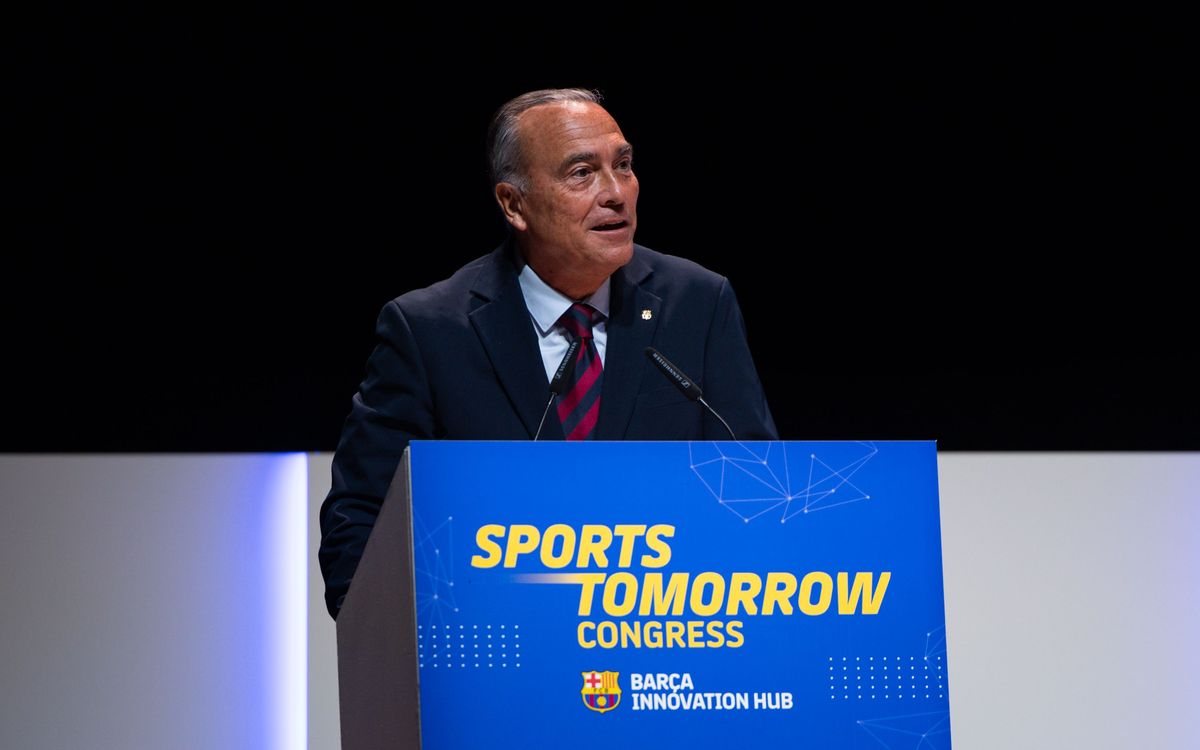

Rafael Yuste: 'Innovation at Barça is not a trend, it's a commitment'
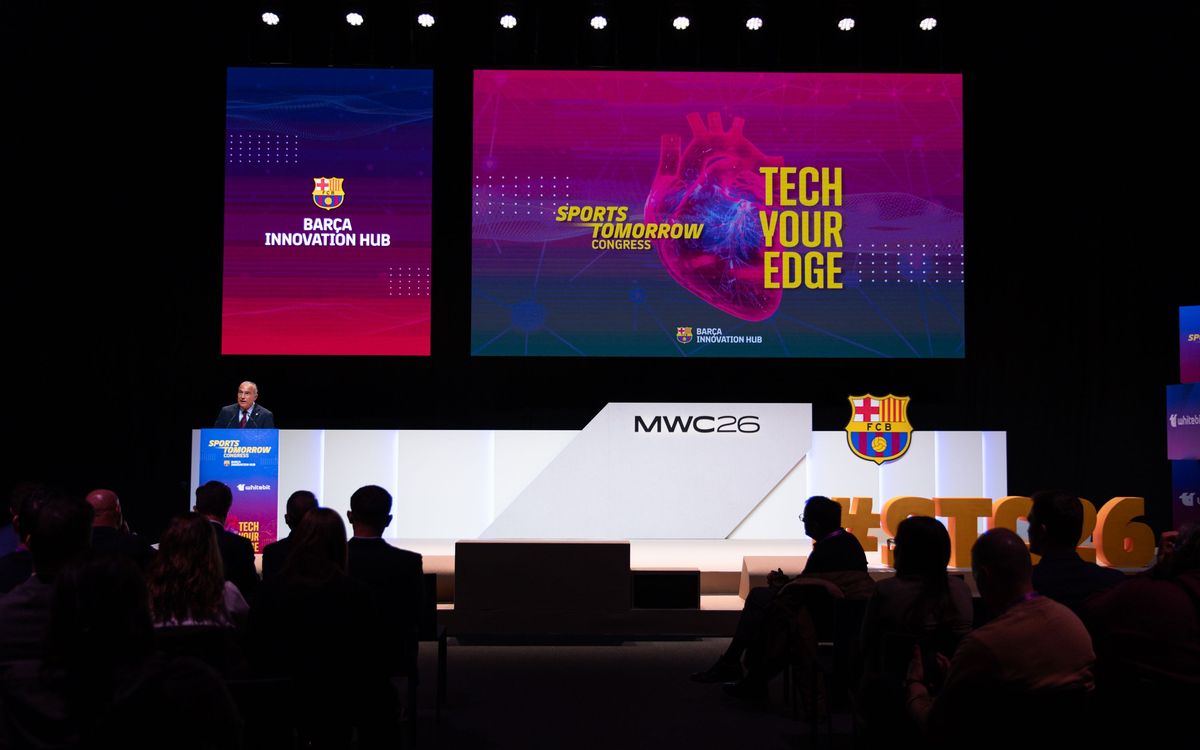
This Monday was the day for the Sports Tomorrow Congress promoted by the Barça Innovation Hub (BIHUB) as part of the Mobile World Congress. Each year, the sports innovation event brings together R&D and technology experts from around the world to discuss the future in these areas. The slogan for this edition was “Tech your Edge”, opening the door to a discussion about how technology is becoming a key tool for amplifying the uniqueness of each sporting institution, both in how it builds its sporting model and in how it develops its business.
FC Barcelona president Rafael Yuste took part in the official closing of the event and stressed that at FC Barcelona “technology is not optional; we have to invest in it to maintain excellence.” He recalled that the club “is investing in La Masia” and in its values programme, which he said “makes our athletes different from other athletes around the world.” Yuste also referred to the club’s Medical Services and their work on injury prevention. “Innovation at Barça is not a trend, it’s a commitment,” he said, citing projects such as Espai Barça, which look to the future through cutting-edge technologies. He ended his remarks by appealing to the human factor, summarising that “technology and AI will make our lives better, but there are two tools that are the heart and soul with which we can all make a better world: the heart and the soul.”
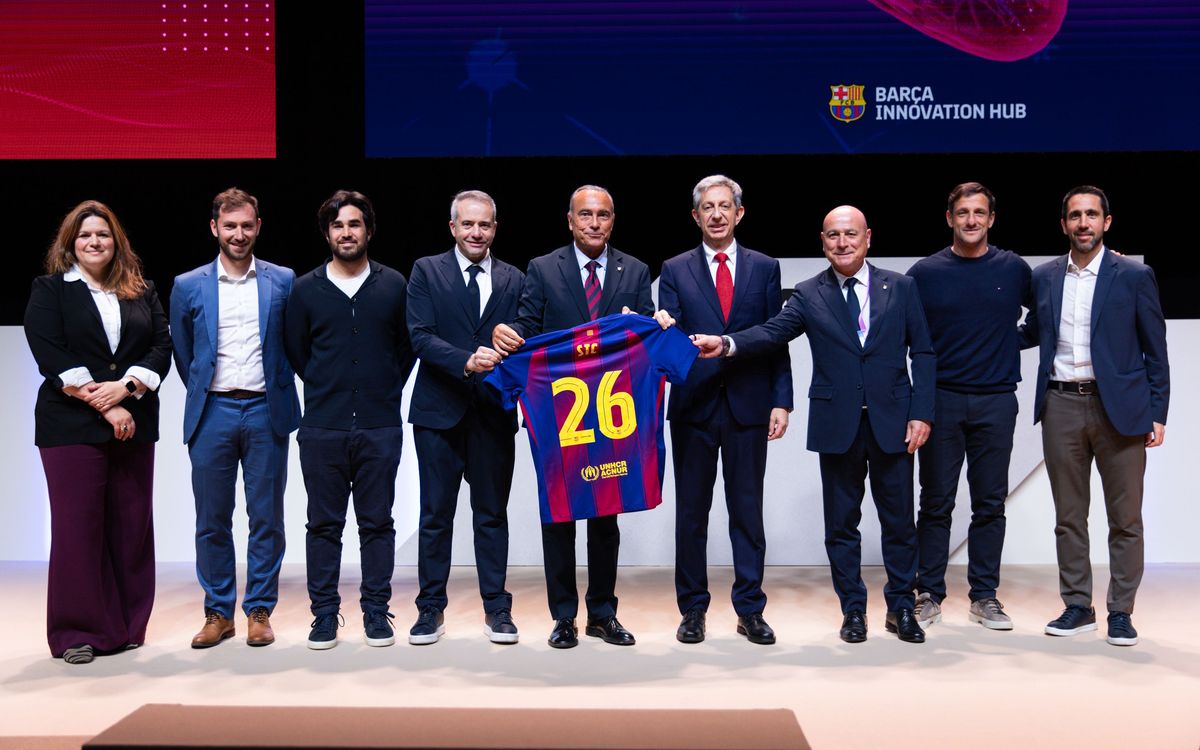
From FC Barcelona’s sporting departments, the women’s first team football coach, Pere Romeu, and the Barça Atlètic coach, Juliano Belletti, were also present at the congress.
Romeu spoke in a session titled “Leading Excellence at Barça Femení”, in which he explained how women’s football has changed on the pitch in recent years. “There has been a lot of physical and tactical improvement in young players; and internationally there is also increasing investment in women’s football,” he noted. Asked whether the structure of women’s football is more open to innovation, Romeu said that because there are not as many established habits as in the men’s game, “new technologies can be tested, things that, as a coach, I want to put into practice.” Romeu also stressed that “data requires context and good interpretation,” and said it is very important that, in relation to this information, “the player feels you are working for her.” In other words, that there is personalisation in order to achieve improvements. He ended his contribution by speaking about psychology, stating that for him “motivation is worked on through small individual and collective goals set periodically with the players.”
Belletti, meanwhile, was the main speaker in the session “Training Young Stars”, in which the Brazilian explained how the culture of hard work and athletes’ physical and academic development has evolved over the years. Belletti also spoke about the mental approach. “The best player in the team will always be the team,” he said. That's something he tries to instil in his players. “I try to help them see where they are so that they can develop individually as footballers, and in that way work so that the team develops too.” Regarding data collection and the associated technology, the Barça Atlètic coach admitted he is “very curious in this respect”, and that “the more information we have, the better.” “Technology helps us evolve our style, we study opponents, and all the numbers we gather help us improve on the pitch.” Belletti also commented that one of the things that helps him most is “listening to the players” to see how they react to day-to-day stimuli and challenges.
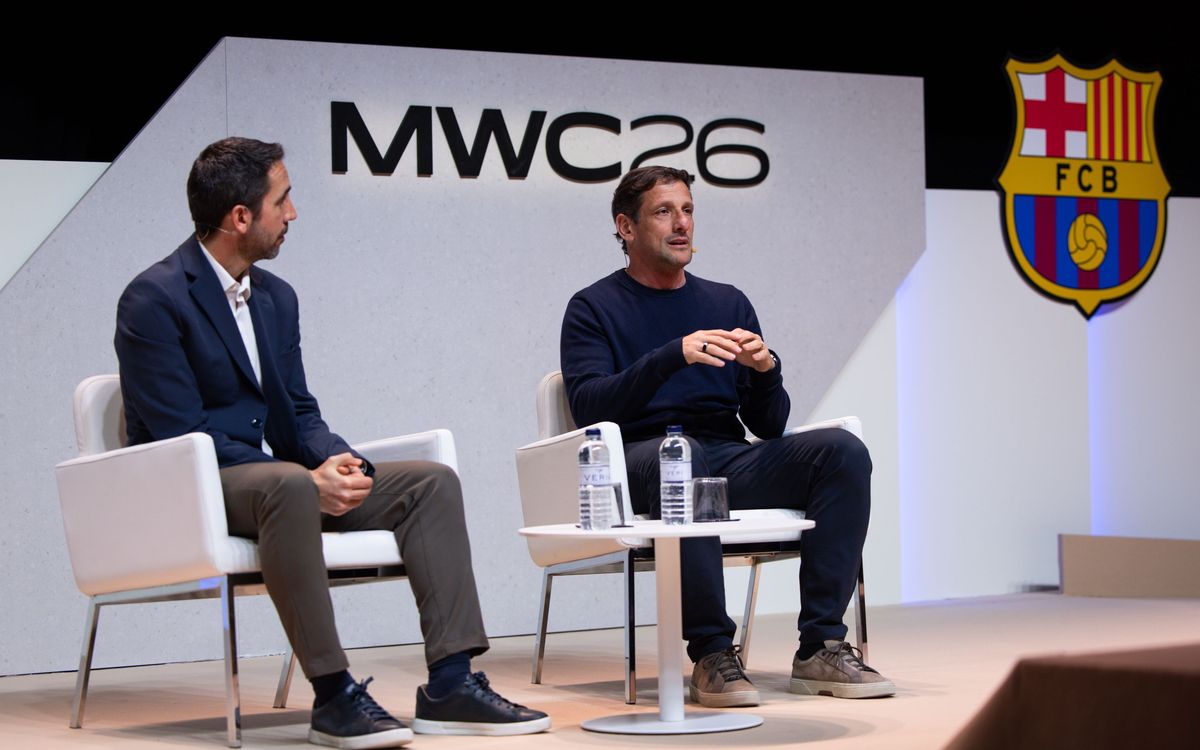
Injury prevention and innovation
During the event, Dr. Gil Rodas, medical director of the Barça Innovation Hub, spoke about epigenetics and injury risk; Vijay Vaswani, co‑founder and CEO of Omniscope, discussed the relationship between the immune system and performance; Xavier Linde, head of physiotherapy and reconditioning at FC Barcelona, delivered a talk on cognitive training and injury prevention; and Mireia Porta, head of sports nutrition at FC Barcelona, revealed the links between nutrition and muscle injuries.
The first round table discussion of the day was led by Laura Isús, co‑founder of Made of Genes, and featured Gil Rodas; Jack Ade, head of sports performance at Liverpool FC; and Ben Simpson, head of sports innovation projects at PSG. The four discussed advances in injury prediction in elite sport through genetic studies and the use of digital twins for athletes.
Technology to improve performance
Irene Mínguez, Director of Research and Development for Grupo Bimbo in EMEA; Marc Bruix, Global Sponsorship Director at FC Barcelona; Álvaro Suárez, co‑founder and CEO of Scircle; Rafal Radawiec, CEO of Adspective; Thomas Rypens, Innovation Director at Club Brugge; Maria Masó, partner at Woldera Tech; and Albert Mundet, General Manager of the BIHUB, also took part as speakers during the morning session.
The second and final round table discussion, held in the afternoon, was moderated by Elisabet del Valle, co‑founder of Onalabs, with Benedikt Kurtz, Head of Health at Garmin, and Claus Biermann, Head of Marketing at Onalabs. The session focused on analysing the possibilities offered by sweat analysis to improve the performance of elite athletes.
Finally, Martin Buchheit, a high‑performance researcher, led a session on data and sports science, and York‑Peter Klöppel, Head of Mental Performance at the Red Bull Athlete Performance Centre, contributed his expertise on mental preparation for sporting challenges.
Tuesday: Hackathon with more than 3,200 registred
The BIHUB also has its own booth at 4YFN, a space that serves as a showcase and driver for start‑ups at this international event. As a new feature this year, it will also take part in the Talent Arena Hackathon at MWC, an event designed for data‑analysis professionals, in which participants will have to solve a challenge based on performance metrics generated in FC Barcelona matches. The challenge will be known as "More than a Hack."
The initiative has been a success, registering more than 3,200 participants from over 95 different countries. From these, 12 groups of five have been selected to compete in the final phase of this data‑analysis challenge, which will take place on 3 March.