

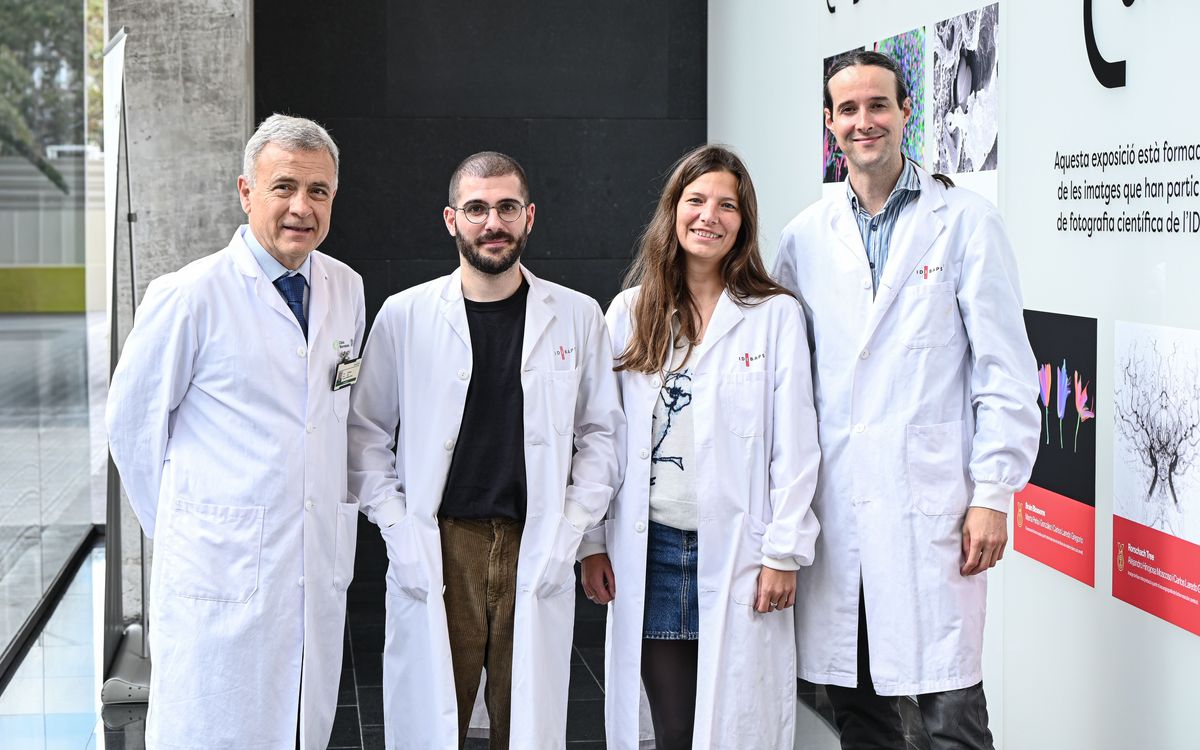
Landmark study by the Barça Innovation Hub and IDIBAPS reveals how epigenetics can explain injury risk in elite football
- label.aria.viber Viber
- label.aria.whatsapp WhatsApp
- label.aria.twitter Twitter
- label.aria.facebook Facebook
- label.aria.messenger Messenger
- label.aria.link label.aria.tick Copy link
Barça Innovation Hub and IDIBAPS have published a groundbreaking article that analyses, for the first time, the epigenome of footballers from both the men’s and women’s teams, exploring whether “biological signatures” exist that help explain why some athletes suffer more injuries than others, and how elite sport may influence biological ageing.
The study was led by Dr Gil Rodas, FC Barcelona team doctor and head of the Sports Medicine Unit at the Hospital Clínic de Barcelona – Hospital Sant Joan de Déu, together with Iñaki Martin-Subero, ICREA researcher and head of the Biomedical Epigenomics research group at IDIBAPS.
Discovery of an epigenetic footprint linked to injury risk
The epigenome can be understood as a switch that turns genes on or off, and which can be modified by lifestyle factors. According to Raúl Fernández Pérez, first author of the study, “epigenetics is a very powerful tool for better understanding how professional sport affects cells at the molecular level.”
Thanks to the detailed collection of injury data from FC Barcelona players (with anonymised samples to protect personal information) the researchers were able to identify footballers with higher or lower susceptibility to injury. By comparing DNA methylation (a chemical process that can activate or silence genes) between these two groups, epigenetic differences were detected.
Although overall differences between players with greater and lesser injury risk were subtle, the study identified more than 1,000 methylation patterns that changed consistently between the two groups. As Gil Rodas explains, “identifying an epigenetic signature associated with injury risk is important, as it will allow us to adjust physical load, nutrition and lifestyle factors to help prevent injuries and enable players to reach their full potential.”
Elite sport and epigenetic age
The research team also used several different “epigenetic clocks” to calculate biological age, an indicator of cellular stress that does not always match chronological age.
One notable finding was that male players showed greater biological age acceleration than female players, in line with previous observations in the general population. However, Martin-Subero points out that “in this case, the differences between men and women were observed in a context of athletes in excellent health and with highly controlled living conditions. The differences in epigenetic age were particularly striking, and we believe they may be linked to the high levels of professionalisation and stress associated with men’s football compared with the women’s game.”
In addition, individuals with higher epigenetic age showed widespread changes in DNA methylation, many related to extracellular matrix and cytoskeleton functions, which are key components of muscle and connective tissues.
Strategic alliance between IDIBAPS–Hospital Clínic and BIHUB
The study was made possible through close collaboration between FC Barcelona’s Medical Services, the Barça Innovation Hub and Clínic-IDIBAPS, as well as the biobank responsible for processing and storing blood samples and carrying out the epigenetic analyses under the supervision of Martin-Subero’s team.
This partnership is unique in the European context, and strengthens the joint commitment of FC Barcelona and leading research centres to a safer, more scientific and fully personalised model of elite sport. The cooperation between top medical institutions and a world-class sports club sets a precedent for integrating advanced biomedical research into athletic performance.
Over the years, BIHUB has developed an extensive international network of collaborators in biomedicine, technology and sports innovation, with the aim of translating laboratory discoveries onto the pitch. As Gil Rodas explains, “at BIHUB we work with leading experts across multiple biomedical disciplines to carry out research of the highest level in the context of elite sport.”
This study represents a major step towards integrating biomedical technologies into professional sport. Combining this new data with advanced statistics and artificial intelligence opens the door to far more precise injury-prediction models, so training loads and lifestyles can be adjusted to prevent injuries and optimise performance.
About the study
- Title: Epigenetic signatures, age acceleration, and injury risk in elite female and male soccer players
- Journal: Scientific Reports
- Participants: 74 male and female FC Barcelona footballers
- Institutions: FC Barcelona · IDIBAPS · Hospital Clínic de Barcelona
- Year: 2025
- Funding: IDIBAPS, Barça Innovation Hub and Illumina
- label.aria.viber Viber
- label.aria.whatsapp WhatsApp
- label.aria.twitter Twitter
- label.aria.facebook Facebook
- label.aria.messenger Messenger
- label.aria.link label.aria.tick Copy link