

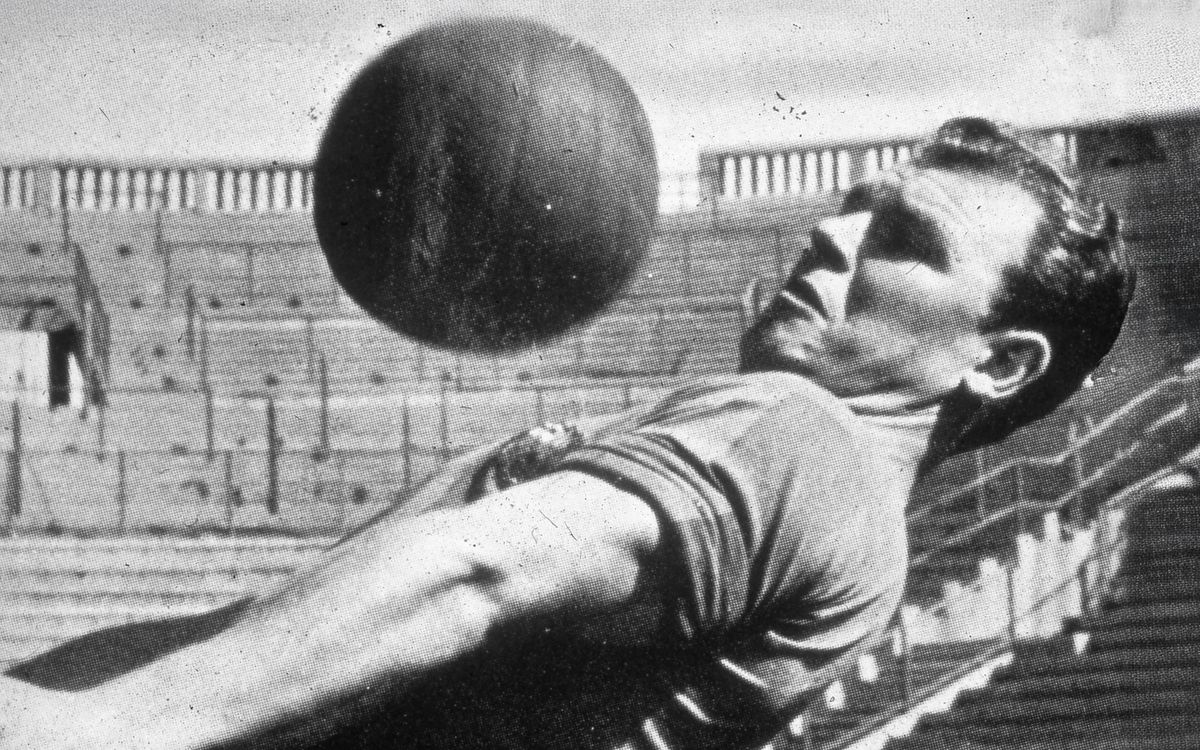

75 years since László Kubala signed
The Hungarian László Kubala (known in Catalonia as Ladislau), an eternal Barça icon, wore the blaugrana shirt from his arrival in 1950 until the end of the 1960-61 season. Sporting director Josep Samitier, who already knew about him, got Kubala to sign for Barça at 8:30pm on 15 June 1950, right after a friendly at Sarrià against Espanyol, when Kubala was playing for Hungaria, the ad-hoc team formed by footballers who had fled the far side of the Iron Curtain.
Kubala was an extraordinary forward, blessed with superlative skills and an impressive physique, excessive in every sense, on and off the pitch. His thighs measured 67 cm in circumference, and he possessed a technique never before seen in Spain. He 'imported' such ideas as curled shots, the quick shuffle when taking penalties, shielding the ball by trapping it between his legs, and several other high-quality innovations at a time when Spanish football was still dominated by rudimentary ideas such as direct play and so-called “fury and fighting spirit.”

Because he was a political refugee being pursued by the Hungarian federation, Kubala’s official debut was delayed. He could not play competitively, now as a naturalised Spaniard, until the 1951 cup. From the moment he debuted, Barça, coached by his brother-in-law Ferdinand Daučik, became a near-unbeatable machine. His team-mates affectionately called him Cabezón (“Big Head” for his leadership), and from day one he was the side’s natural leader, even though he earned six times more than the club’s second-best-paid player, César Rodríguez, who would, without exaggeration, become Kubala’s big brother and soulmate. With Kubala, Barça enjoyed two brilliant seasons up to 1953, winning almost every competition on offer, the legendary Five Cups era.
Throughout the 1950s, Kubala was the most famous man in Catalonia, a mass phenomenon almost impossible for today’s generations to grasp, surpassing, in its context, even the popularity that Leo Messi recently enjoyed or that Lamine Yamal is starting to experience now.
People adapted popular songs for him, for instance, the dance tune La Raspa: “La raspa la inventó / Kubala con un balón / Kubala pasa a César / y César remata a gol.”
Or the children's playground rhyme that went: “Silencio en la sala, que pasa Kubala, con una chavala vestida de gala.”
He even starred in a film, Los ases buscan la paz (“Aces Seek Peace”), an embellished biopic of his escape from Hungary and his triumph in Barcelona. Kubala died in 2002, and on the Feast of La Mercè in 2009 a statue of him was unveiled on the esplanade outside the Camp Nou’s main stand.